
5 October 2026
A Practical Guide to Buying Particle Board Furniture : Why Two Similar-Looking Bedroom Sets Can Be Very Different in Quality
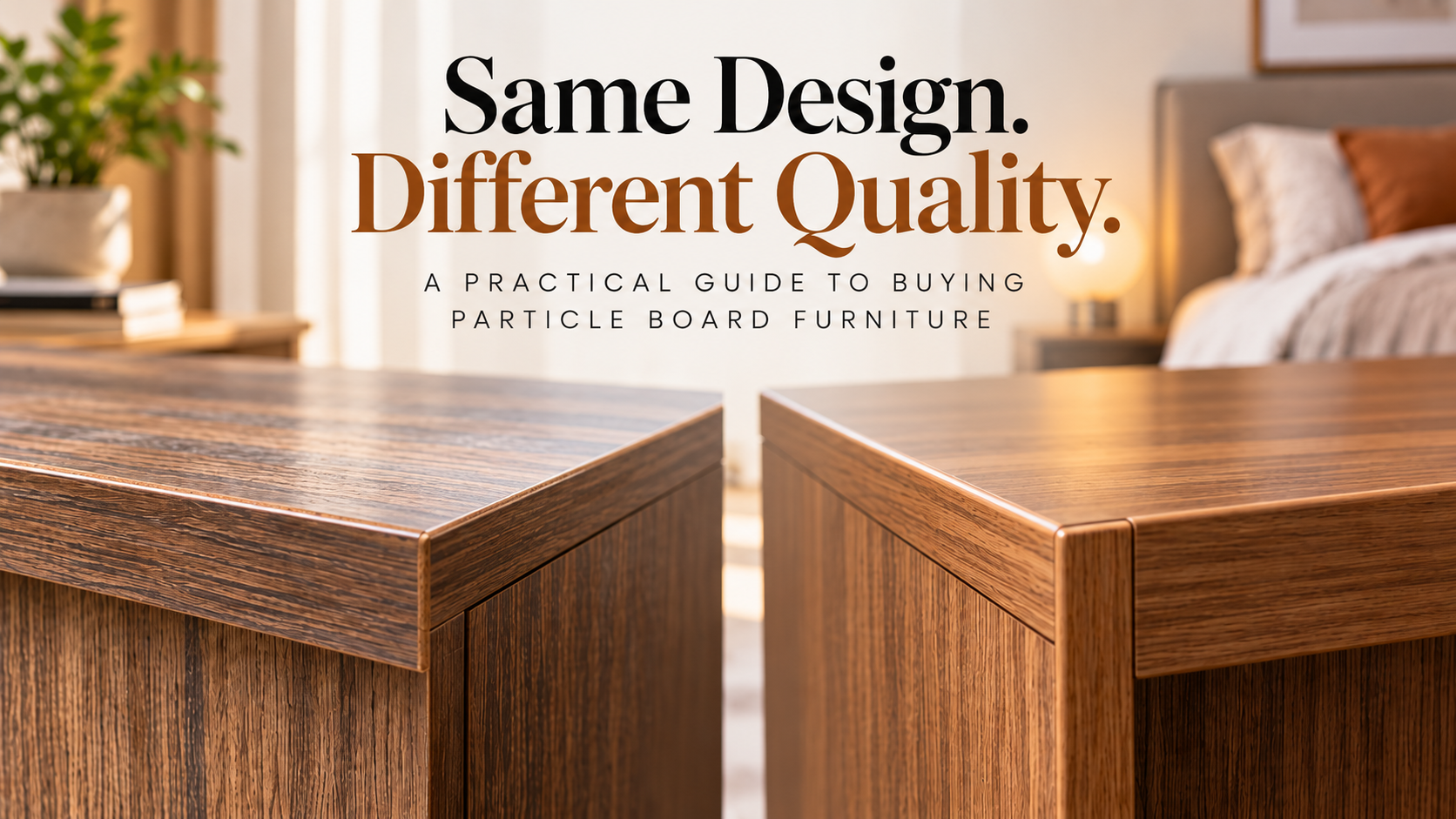
Shopping for furniture today can be confusing. Browse through a few furniture stores or online marketplaces, and you'll find bedroom sets that look remarkably similar. The designs are almost identical, the product descriptions sound the same, and the photographs make it difficult to tell them apart.
Yet the prices can vary considerably.
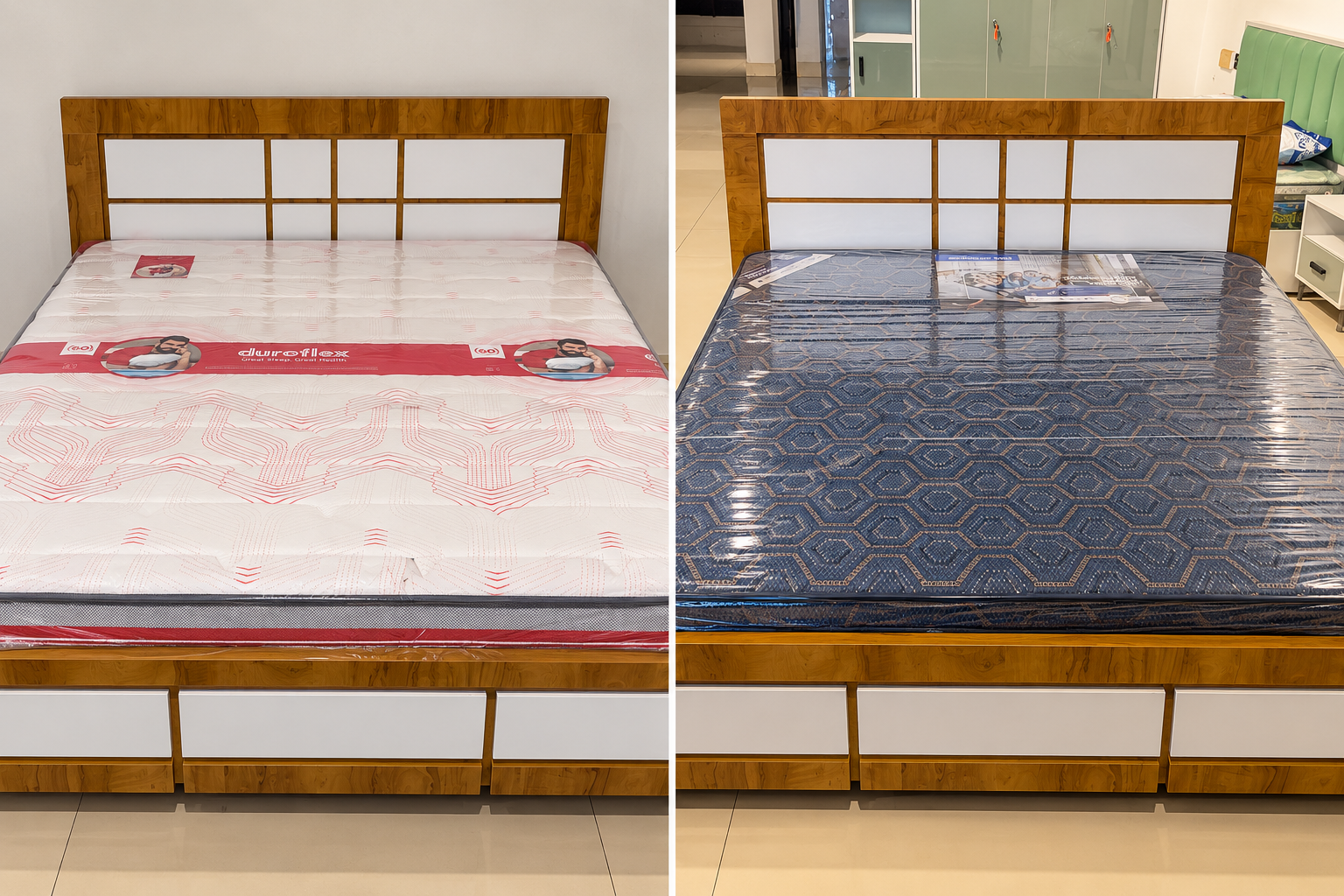
These two cots from the same brand looks similar in the photographs; but the one on the left is 35% more expensive than the one on the right.
So, are you simply paying more for the same furniture?
Not necessarily.
When it comes to particle board furniture, what you see on the outside doesn't always tell you the whole story. The quality of the board, its thickness, edge finishing, hardware and craftsmanship can make a significant difference to how furniture performs over time.
Before buying your next wardrobe or bedroom set, here are some important things worth checking.
1. Not All Particle Boards Are Created Equal
Particle board has become a popular material for modern furniture because it allows manufacturers to produce attractive, functional furniture at accessible prices.
However, particle boards can vary in density, internal bonding, surface finish and moisture resistance.
Two wardrobes might both be described as being made from engineered wood or particle board, but that doesn't necessarily mean they're made from boards of equivalent quality.
A well-manufactured board, selected appropriately for its intended use, can provide reliable performance under normal household conditions. Poor-quality boards may be more vulnerable to issues such as weakened screw connections, surface damage or swelling when exposed to moisture.
What should you ask?
- What type and grade of particle board is used?
- Is the board suitable for the intended application?
- Does the manufacturer provide information about the board's quality and moisture resistance?
Remember, the term engineered wood describes a broad category of materials. It isn't a guarantee of quality by itself.
2. Board Thickness: A Detail Worth Checking
One of the easiest specifications to overlook when comparing furniture is board thickness.
Particle board furniture is manufactured using different thicknesses, commonly including 12mm, 15mm and 18mm, depending on the design and application.
Thickness can influence a panel's stiffness, its ability to support loads and how it performs over time.
For example, a long wardrobe shelf made from a thinner board may be more likely to sag under heavy loads than a thicker shelf of comparable material and construction.
However, thicker doesn't automatically mean better. Board quality, shelf span, support, fastening methods and overall design are equally important.
When comparing two bedroom sets, ask about the thickness of the major structural panels, shelves, wardrobe doors and other load-bearing components.
A bedroom set with thicker, appropriately supported panels may cost more to manufacture than one designed primarily to minimise material costs.
These differences aren't always visible in a photograph.
3. Edge Banding: The Small Detail That Deserves Big Attention
Particle board has a compressed wood-particle core. When the board is cut, its edges need appropriate finishing and protection.
Edge banding is the material applied to these exposed edges, often using PVC, ABS or other suitable materials.
Good edge banding serves two purposes: it creates a clean, finished appearance and helps protect vulnerable board edges from everyday wear and incidental moisture exposure.
But not all edge finishing is equal.
Differences can include the thickness and quality of the edge-banding material, adhesive performance, application accuracy and finishing.
Here's what to look for:
- Edges should appear smooth and evenly finished.
- The banding should adhere firmly without visible peeling or lifting.
- Corners should be neatly trimmed.
- There should be no obvious gaps between the banding and the board.
- Exposed particle-board edges should be appropriately protected.
Poorly applied edge banding may eventually lift or allow moisture to reach vulnerable areas of the board.
This is particularly relevant in Kerala, where humid conditions and seasonal monsoon weather make moisture protection an important consideration.
Even well-finished particle board is not waterproof unless specifically designed and certified for that purpose. Furniture should still be protected from standing water, leaks and prolonged dampness.
A simple tip: Don't just admire the front of a wardrobe. Open the doors and examine the edges of the shelves, panels and drawers.
Sometimes, the smallest details reveal the most about manufacturing quality.
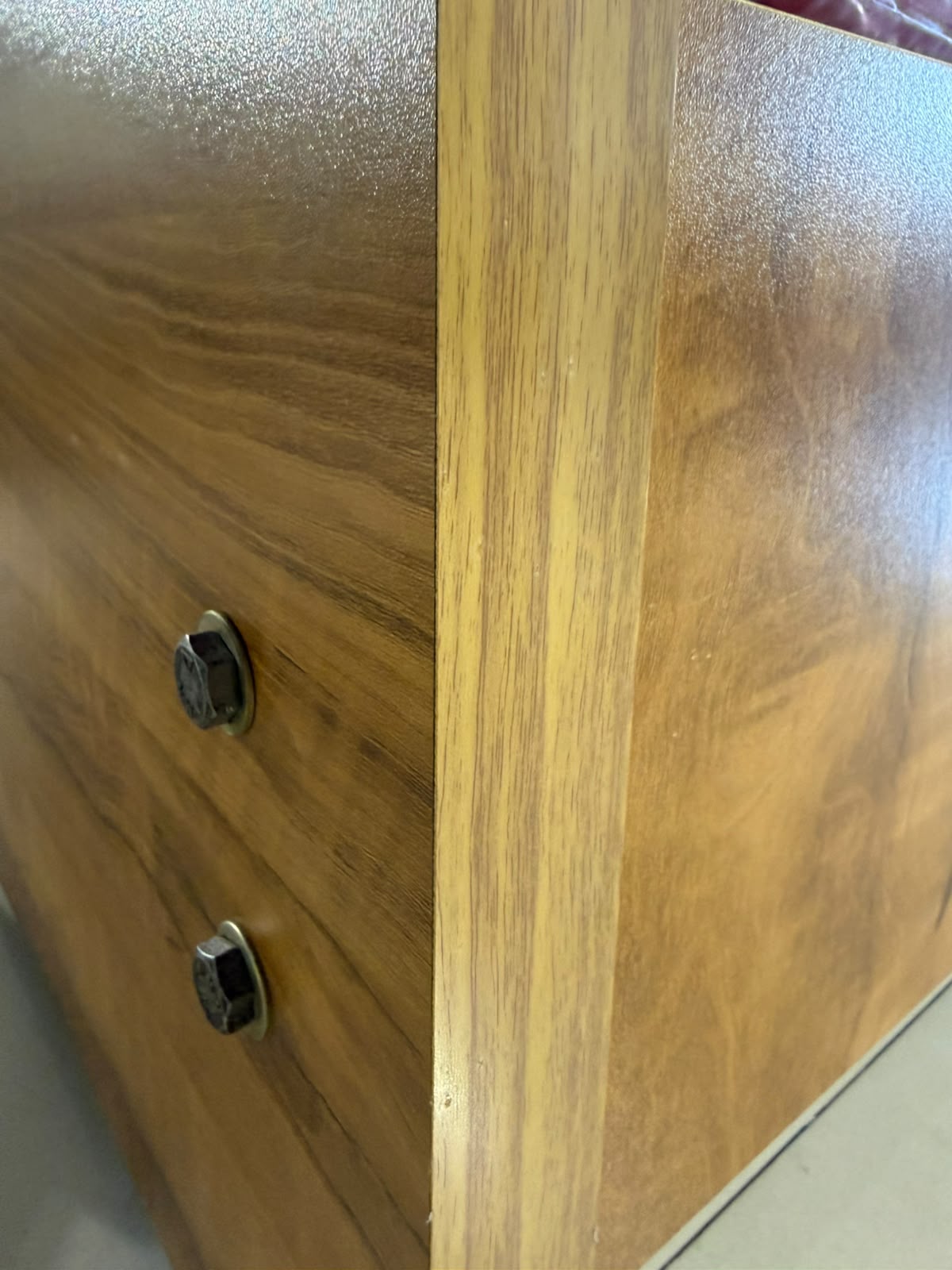
This shows 0.5mm edge banding. It is commonly used for areas that experience less impact and wear. When comparing furniture, consider where the piece will be used and how much everyday use the edges will receive.
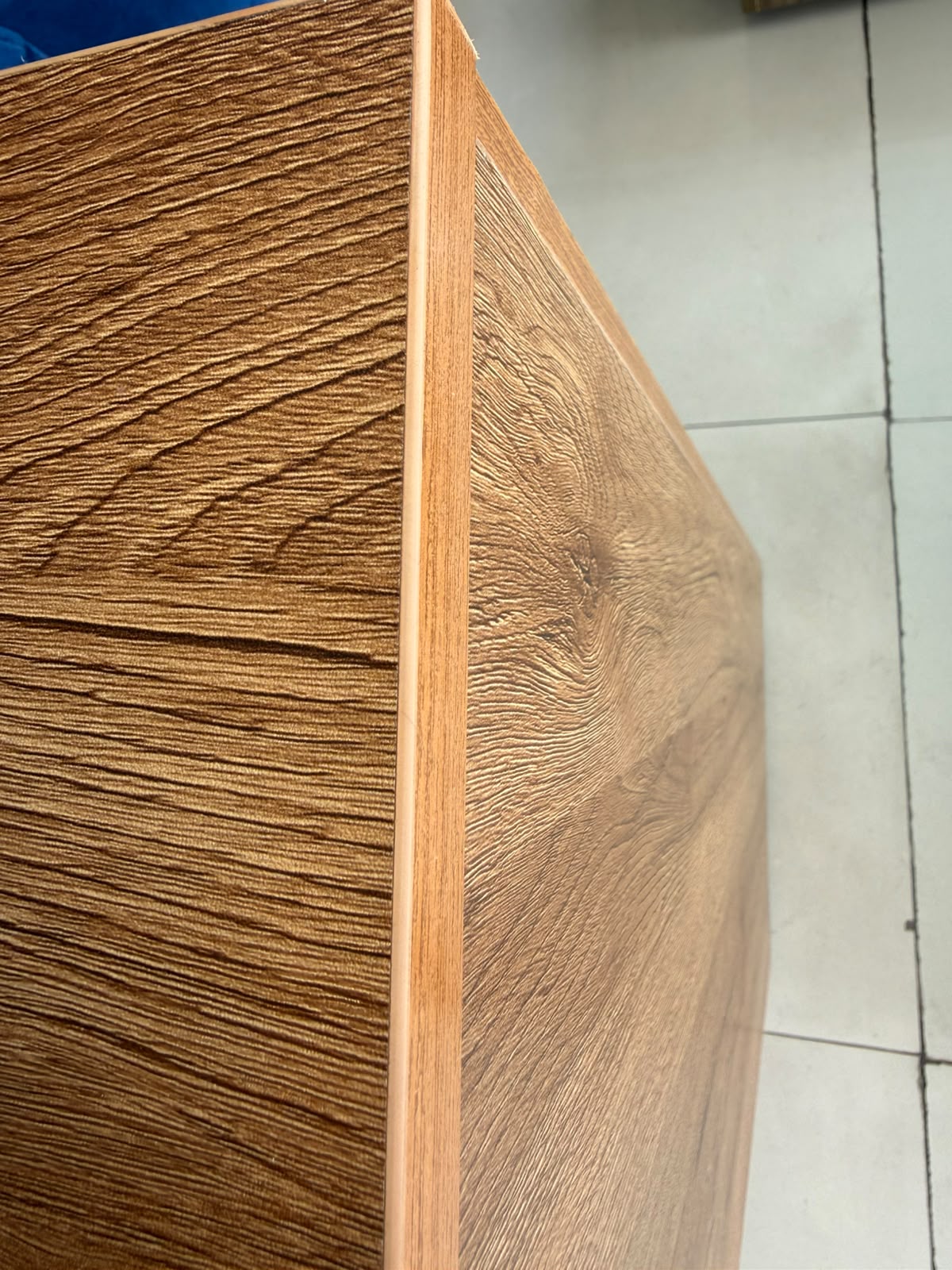
This shows 2mm edge banding. Its greater thickness provides additional protection against everyday knocks and wear, making it a suitable choice for high-use areas. A well-applied edge band also helps protect the exposed board edge from moisture.
4. Hardware: The Parts You Use Every Day
When customers compare bedroom sets, they naturally focus on the wardrobe design, bed finish and overall appearance.
But think about how frequently you use your furniture.
Wardrobe doors may be opened several times a day. Drawers are repeatedly pulled out and pushed back. Hinges, runners and connectors experience regular use.
The quality of these components matters.
A good-looking wardrobe fitted with unsuitable or poorly installed hardware may develop problems such as stiff drawers, loose hinges or doors that no longer close properly.
Before buying, check the following:
- Hinges: Do the doors open and close smoothly?
- Drawer runners: Do drawers move without sticking or excessive wobbling?
- Handles: Are they securely fitted?
- Connectors: Does the furniture feel stable when used normally?
- Mechanisms: If the furniture has hydraulic storage or soft-close fittings, do they operate smoothly?
Not every piece of furniture needs expensive imported hardware. What matters is that the components are suitable for the design, properly installed and capable of handling their intended use.
5. Craftsmanship: Why Assembly and Precision Matter
Even when two manufacturers use similar materials, the finished furniture may not be of the same quality.
Why?
Because materials are only part of the equation.
The accuracy of cutting, drilling, edge finishing, assembly and installation also matters.
Consider a wardrobe with two doors.
From a distance, it might look perfectly fine. But look a little closer.
Are both doors aligned at the top? Is the gap between them consistent? Do they close without rubbing against each other? Are the shelves level?
These details can indicate the care taken during manufacturing and assembly.
Poor alignment may result from inaccurate manufacturing, improper assembly, uneven flooring or hinges that need adjustment. It doesn't always mean the board itself is defective.
A useful showroom test: Open and close the wardrobe doors several times. Inspect the gaps, check the drawer movement and look at the finishing around the corners.
Good craftsmanship is often most noticeable in the details customers don't immediately think to inspect.
6. The Real Cost of Furniture Isn't Always on the Price Tag
Imagine comparing two bedroom sets.
Both include a bed, wardrobe, dresser and bedside table.
Both have a similar finish.
Both look attractive in photographs.
Yet one costs significantly less than the other.
It's tempting to assume that the cheaper set offers better value.
Sometimes it might. But before deciding, consider whether the two sets are genuinely comparable.
Does one use a different board grade or thickness? Is the edge finishing different? Are the hinges and drawer runners equivalent? Is the construction equally sturdy? What about installation, warranty and after-sales service?
A lower purchase price doesn't necessarily mean poor quality. Equally, a higher price doesn't guarantee superior construction.
The important question isn't simply, "Which one costs less?"
It's "What am I getting for the price I'm paying?"
7. Warranty: Understand What Happens After the Purchase
Furniture is something you expect to use for years.
That's why the warranty deserves as much attention as the appearance and price.
Before purchasing, ask what the warranty actually covers.
Does it cover manufacturing defects? Does it include hardware? Are problems caused by moisture, misuse or improper installation excluded? Who handles service requests, and are there any charges?
A warranty should be clearly explained, ideally in writing.
Remember that different manufacturers and retailers may offer different warranty terms. A long warranty period isn't necessarily more valuable if its coverage is extremely limited.
The important thing is to understand both the protection being offered and the process for obtaining service.
8. Why the Retailer You Buy From Matters
There's another consideration that customers sometimes overlook: the retailer behind the furniture.
Furniture isn't necessarily a one-time transaction. You may need installation assistance, replacement hardware, adjustments or help with a manufacturing issue months or even years after your purchase.
That's why the retailer's experience and track record matter.
An established furniture business has something that cannot be built overnight: a history of serving customers and standing behind the products it sells.
At Touchwood Furniture, we've been serving customers for 30 years.
Three decades in furniture doesn't mean that every product is perfect or that newer businesses cannot offer good furniture. What it does mean is that we've had the opportunity to learn what customers value, understand the products we sell and build a business around long-term relationships rather than one-time transactions.
When you're making a significant furniture purchase, consider asking:
- How long has the business been operating?
- Do they have a physical showroom?
- Is there a clear warranty?
- Who will handle service if something goes wrong?
- Can they provide replacement hardware or parts when required?
- Will there be someone you can contact after the sale?
When you buy furniture, you're not just buying the product. You're also choosing the people who will stand behind it.
And when you're buying something you expect to live with for many years, that relationship matters.
Your Particle Board Furniture Buying Checklist
Save this checklist and take it along the next time you shop for furniture.
- Ask about the quality and grade of the particle board.
- Check the thickness of major panels and shelves.
- Inspect edge banding for gaps, peeling or rough finishing.
- Look for exposed or poorly protected board edges.
- Open and close all wardrobe doors.
- Check that doors are properly aligned.
- Test drawer runners and hinges.
- Inspect corners, joints and overall craftsmanship.
- Ask about moisture protection and recommended care.
- Understand exactly what the warranty covers.
- Ask how after-sales service and repairs are handled.
- Consider the reputation and track record of the retailer.
Final Thoughts: Buy Better, Not Just Cheaper
Particle board furniture can be a practical and attractive choice for modern homes when the materials, design and construction are appropriate for their intended use.
But not all particle board furniture is built to the same standard.
Two bedroom sets may look identical in photographs and have similar descriptions, yet differences in board quality, thickness, edge finishing, hardware and craftsmanship can affect their performance over time.
Take a little extra time to inspect the details, ask questions and understand what you're buying.
Because good furniture isn't just about how it looks on the day you buy it. It's also about how well it serves you in the years that follow.
About Touchwood Furniture
At Touchwood Furniture, Kozhikode, we believe that informed customers make better purchasing decisions. We encourage you to examine furniture closely, ask questions about materials and construction, and compare more than just prices.
Visit our showroom on Wayanad Road, East Nadakkavu, Kozhikode, to explore our furniture collections.
Website: https://touchwoodfurniture.in/